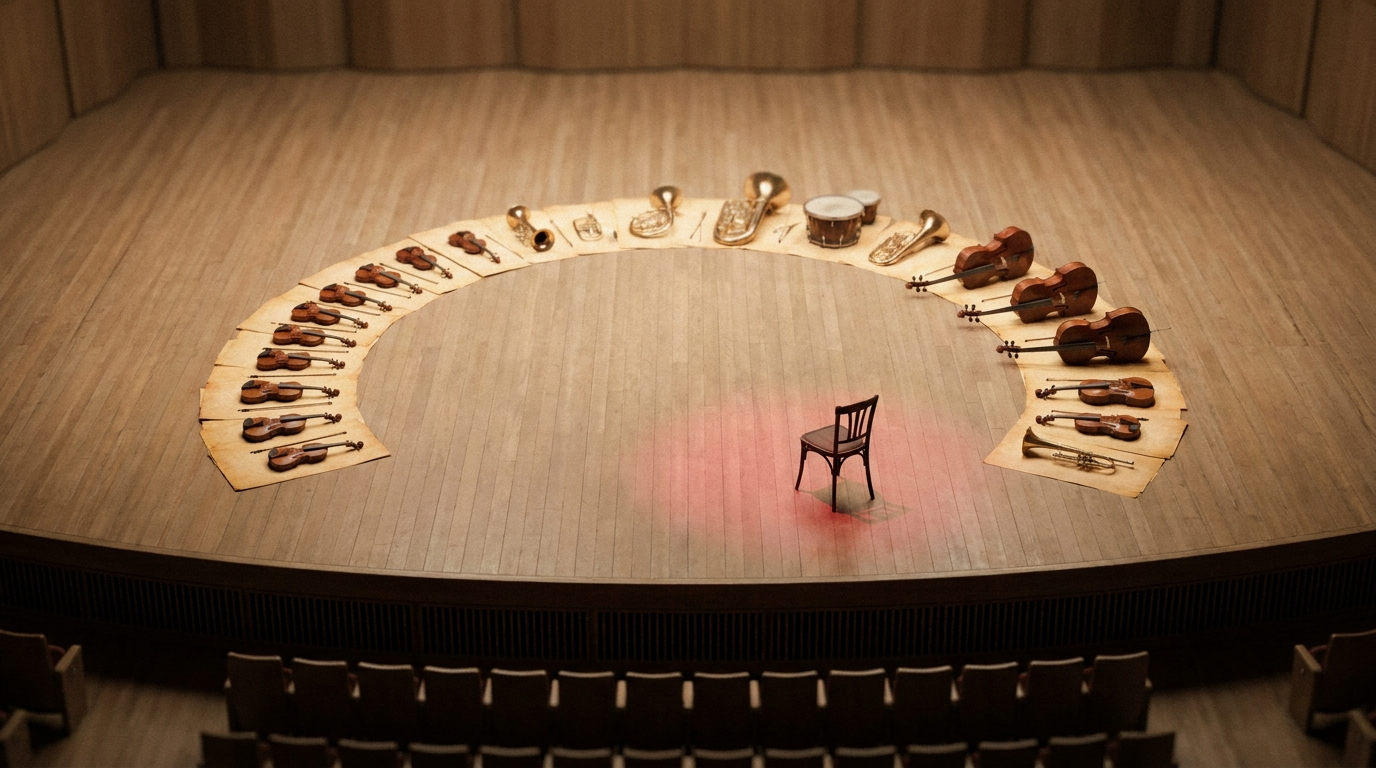
Picture the room every leader thinks they want. Three of the smartest people you have ever met, sitting around one table, told to solve the hardest problem in the company. The resumes are spotless. The track records speak for themselves. On paper, this is a dream team.
On paper. In the room, something quieter is happening. Each of them is solving a slightly different problem, in a slightly different language, while keeping one eye on how they look to the other two. The output is not a breakthrough. It is a negotiated draw.
This is the mistake hiding inside most ambitious companies. They believe that if you gather enough talent, a team will assemble itself. It will not. Talent is the raw material. A team is something you build on purpose.
Hiring three brilliant people does not give you a creative team. It gives you three soloists waiting to find out who is in charge.
Why brilliance competes instead of compounds
Brilliant people did not get where they are by blending in. They got there by being right, often, in rooms full of people who were wrong. That instinct is an asset right up until the moment you ask them to create something together.
Put three of them in a room with no shared language and no defined roles, and the work quietly turns into a contest. Whose framing wins. Whose idea survives. Who gets to be the one who saw it first. Energy that should be aimed at the problem gets spent on position instead.
It does not look like conflict. It looks like a polite meeting where good ideas get softened, risky ideas never get said, and everyone leaves convinced they were the most reasonable person there. The brilliance is real. It is just pointed sideways.
What is missing is not more talent. It is the thing that lets talent add up. A way of working where one person's idea becomes the floor the next person builds on, instead of the wall they have to climb over.
An ensemble is one instrument with many parts
Think about an orchestra. It is not a collection of excellent musicians taking turns. The violinist is not trying to outplay the cellist. Nobody is performing a private solo on top of everyone else. For the length of the piece, dozens of people behave as a single instrument with many parts.
That does not happen because the players are humble. It happens because they share a score, they know exactly which part is theirs, and they trust the person beside them to hold their line. Remove any one of those and you do not get music. You get noise that happens to be in the same room.
A creative team works the same way. The talent in the chairs matters far less than whether those chairs add up to one instrument. And that is something you tune, not something you hope for.
A team that creates together will beat a room full of soloists every time, even when the soloists are individually better.
The three things that turn talent into an ensemble are not mysterious. They are a shared language, clear roles, and the safety to be wrong out loud. None of them arrive on their own, and all three can be built.
A shared language is what lets people argue about the work instead of past each other. When a team agrees on what a good idea looks like, how it gets pressure-tested, and what counts as finished, the conversation stops being a clash of styles and becomes actual progress.
Clear roles are what keep brilliance from colliding. In a real ensemble, knowing your part is not a limit on your contribution. It is what frees you to go all in on it, because you are not also fighting for territory that already belongs to someone else.
And the safety to be wrong out loud, the thing now widely known as psychological safety, is the quiet engine underneath both. The best idea in the room is useless if the person holding it has decided it is not worth the risk of saying. Teams that punish the half-formed thought never hear the brilliant one that was hiding behind it.
Where we learned this, and why it works
We did not develop this view in a workshop. We built it inside film and production teams, where a group of strangers has to become a single creative instrument in days, deliver under a schedule that does not bend, and do it while the plan changes around them. There is no time for the polite draw. The work has to be good, and it has to be good now.
What we found there holds up everywhere. Under real pressure, a tight team of capable people consistently outperforms a loose group of stars. The stars protect their reputations. The team protects the work. When the deadline is real, that difference decides everything.
This is the part most companies get backwards. They treat team chemistry as a personality question, something you solve by hiring people who get along. But getting along is not the same as creating together. Pleasant teams produce safe, forgettable work all the time. What you are actually building is a way of working that turns disagreement into fuel.
Creativity is the most valuable asset a business has now, and it is trainable. Not just in the individual, but in the space between people. You can train a group to think as one instrument the same way you train anything else that matters. Deliberately, under pressure, until it holds when it counts.
So the question is not whether you have hired brilliant people. You probably have. The question is whether you have done the harder, more valuable work of turning them into a team that compounds instead of competes.
Stop collecting soloists. Build the instrument.